
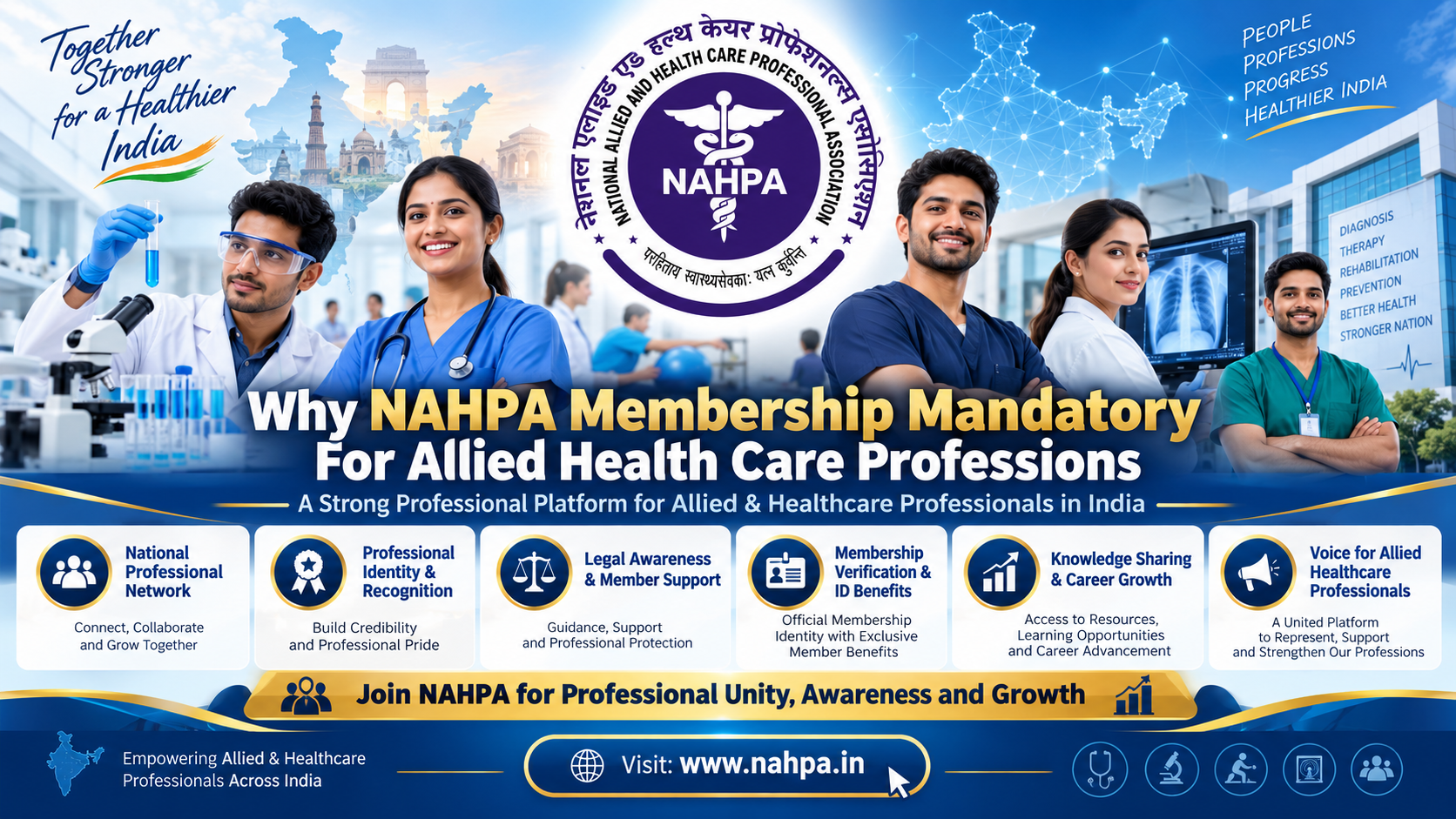
Why NAHPA Membership Mandatory For Allied Health Care Professions
India's healthcare system is rapidly evolving, and allied and healthcare professionals are becoming an increasingly important part of patient care, diagnostics, rehabilitation, emergency services, laboratories, imaging, physiotherapy and community healthcare.
With the implementation of the National Commission for Allied and Healthcare Professions Act, 2021, the professional environment for allied and healthcare workers in India is also moving toward greater standardisation, professional accountability and structured regulation.
In this changing environment, professionals need more than an educational qualification. They need professional awareness, networking, representation, guidance and an organized platform where their professional interests can be collectively discussed.
This is where the National Allied and Healthcare Professional Association (NAHPA) can play an important role.
For many allied healthcare professionals, NAHPA membership can therefore be viewed as an increasingly important professional step.
Important Clarification About the Word “Mandatory”
Before discussing the benefits of NAHPA membership, one distinction must be clearly understood.
NAHPA membership should not be confused with statutory registration required under any applicable law or by a competent government regulator.
The National Commission for Allied and Healthcare Professions Act, 2021 establishes the statutory framework for regulation of allied and healthcare professions, including professional standards and maintenance of registers. The National Commission for Allied and Healthcare Professions has also clarified that decisions relating to registration norms, practice norms, institutional standards, professional status and professional ethics for professions under the Act are matters for NCAHP.
Therefore, in this article, “mandatory” is used in the sense of professional importance and organizational value, not as a claim that NAHPA membership is legally compulsory for every allied healthcare professional in India.
What is NAHPA?
NAHPA – National Allied and Healthcare Professional Association is a professional association focused on allied and healthcare professionals in India.
Its website provides facilities relating to membership, member records, member ID cards and certificates, organizational office bearers, a help desk and information about its organizational network.
NAHPA's website lists state and district-level office bearers from various parts of India and also provides facilities to apply for membership and search its registered member database.
The core idea behind such an association is simple:
Bring allied and healthcare professionals together on a common professional platform.
As healthcare becomes increasingly multidisciplinary, this type of collective professional organization can become valuable for professionals who otherwise operate independently across different occupations and locations.
Why NAHPA Membership is Important for Allied Healthcare Professionals
1. A Common National Platform for Allied Healthcare Professionals
One of the biggest challenges faced by allied healthcare professionals is fragmentation.
Medical laboratory professionals may have different professional concerns from physiotherapy personnel. Radiology and imaging professionals may face different challenges from emergency care personnel, optometry professionals or other allied healthcare workers.
Yet many of their larger concerns overlap.
These may include:
professional recognition,
career development,
professional standards,
workplace concerns,
regulatory awareness,
public awareness,
ethical practice,
and professional representation.
NAHPA provides an organizational platform through which professionals from different allied healthcare categories can connect with a wider professional community.
This type of common platform can strengthen communication and cooperation across the sector.
2. Professional Identity and Networking
Professional identity matters in healthcare.
Being part of a professional association can help individuals move beyond working in isolation and become part of a larger professional network.
NAHPA maintains a membership system and member database and displays national, state and district organizational structures on its official website.
Professional networking can help members interact with:
fellow allied healthcare professionals,
senior professionals,
professional organizations,
healthcare institutions,
subject experts,
legal professionals,
and sector stakeholders.
Networking does not automatically guarantee employment or professional advancement, but it can create opportunities for knowledge sharing, collaboration and professional engagement.
3. Awareness of Changes in the Allied Healthcare Sector
India's allied healthcare regulatory environment has changed significantly following the enactment of the National Commission for Allied and Healthcare Professions Act, 2021.
The Act provides for regulation and maintenance of standards of education and services by allied and healthcare professionals and for maintaining Central and State Registers.
NCAHP has further stated that it is developing standards relating to registration, practice, institutions, professional status, clinical establishments and professional ethics for professions covered by the Act.
For professionals, keeping track of these developments can be difficult.
An active professional association can assist its community by circulating information, discussing regulatory developments and creating awareness about changes affecting the sector.
This makes professional association membership increasingly relevant in a changing regulatory environment.
4. Collective Professional Representation
An individual professional may have limited ability to raise broad sectoral concerns alone.
A professional association can bring similar concerns from multiple professionals onto a common platform.
Collective representation may involve issues relating to:
professional awareness,
working conditions,
professional identity,
policy concerns,
professional standards,
education and training,
career opportunities,
and sector development.
The purpose of professional representation should not be confused with statutory regulatory authority.
Rather, an association can act as a platform through which members communicate their views and concerns to relevant stakeholders.
This distinction is especially important in the allied healthcare sector.
5. Professional Guidance and Member Support
Healthcare professionals frequently face situations where they need clarity regarding professional documentation, organizational procedures, regulatory developments or other professional issues.
NAHPA's website currently provides a Help Desk and lists contact facilities for members and other users seeking assistance.
A structured association can provide a starting point for members seeking general organizational guidance or direction toward an appropriate resource.
Where legal issues are involved, members should always obtain advice from a qualified legal professional relevant to their specific circumstances.
Professional association support should be regarded as supplementary support rather than a substitute for a statutory regulator, government authority or court.
6. Legal Awareness and Access to Professional Support
Allied and healthcare professionals sometimes encounter employment disputes, documentation issues, complaints, establishment-related matters or misunderstandings about their permitted professional roles.
Legal awareness therefore has considerable importance.
NAHPA's official website lists a Legal Cell and organizational resources connected with member support.
A professional association with legal professionals or legal-awareness initiatives can help members understand that professional disputes should be handled through lawful procedures and appropriate authorities.
However, membership in an association does not provide immunity from law, guarantee a favourable legal outcome or replace statutory registration and licensing requirements.
The real benefit lies in awareness, access to guidance and organized professional support.
7. Membership Verification and Professional Documentation
Trust and verification are becoming increasingly important in healthcare.
NAHPA's website provides facilities relating to registered members, including a member database, NAHPA ID cards, certificates and profile-related services.
A transparent member-verification mechanism can make it easier to confirm whether an individual is actually affiliated with an organization.
It is important, however, to understand the distinction between:
Association Membership Verification
and
Government/Statutory Professional Registration.
A NAHPA membership certificate or ID card establishes association membership according to NAHPA's own membership system.
It should not be represented as a replacement for any registration, licence or authorization legally required from NCAHP, a State Council, government authority or another competent statutory body.
8. Building a Stronger Voice for Allied Healthcare Professionals
Doctors, dentists, nurses and several other professional categories have historically benefited from organized professional bodies and associations.
Allied healthcare professionals are a broad and diverse workforce.
As this workforce expands, creating communication and cooperation between professionals becomes increasingly valuable.
NAHPA's national, state and district organizational structure is intended to provide a network through which professionals can participate at different levels. Its website currently lists numerous state and district office bearers across India.
Greater participation can help the profession develop a stronger collective voice.
9. Professional Development and Knowledge Sharing
Healthcare does not remain static.
New technologies, diagnostic techniques, regulatory requirements, standards and patient-care approaches continue to emerge.
Professionals therefore need continuous learning and professional interaction.
Professional associations can facilitate:
seminars,
professional meetings,
workshops,
awareness programmes,
expert discussions,
professional publications,
digital learning,
and knowledge exchange.
Such activities can contribute to continued professional development when delivered by appropriately qualified experts and institutions.
For a healthcare professional, remaining connected with developments in the profession can be just as important as the qualification originally obtained.
10. Understanding Professional Rights and Responsibilities
Professional associations should not focus only on rights.
Responsibilities are equally important.
Healthcare professionals work in a sensitive environment directly connected with patient safety, public health and professional ethics.
Professionals should understand:
their scope of practice,
ethical responsibilities,
documentation requirements,
patient safety principles,
applicable laws,
professional standards,
and limitations of their qualifications.
NCAHP's public notice emphasizes that standards concerning registration, practice, institutions, professional status and professional ethics for covered professions fall within the Commission's framework.
Associations can support this ecosystem by promoting awareness and encouraging members to follow applicable statutory requirements.
11. Connecting Professionals at National, State and District Levels
A professional issue experienced in one district may also be affecting professionals in other areas.
Without an organizational network, these experiences often remain isolated.
NAHPA displays office bearers at national, state and district levels, giving the association a multi-level organizational framework.
Such a structure can facilitate communication between local professionals and broader organizational leadership.
This is particularly useful in a country as geographically large and professionally diverse as India.
12. Greater Participation in the Future of Allied Healthcare
The allied healthcare sector in India is undergoing structural development.
The NCAHP Act was enacted specifically to provide a framework for regulating education and services, assessing institutions, maintaining professional registers and improving standards across allied and healthcare professions.
Professionals who remain aware, organized and engaged will be better positioned to understand these changes.
Participation in a professional association can give professionals an additional platform for discussion and professional engagement as the sector develops.
NAHPA Membership vs NCAHP Registration: Understand the Difference
This is one of the most important points for every allied healthcare professional.
NCAHP is a statutory framework created under an Act of Parliament.
NAHPA is a professional association.
Their functions should therefore not be confused.
NCAHP is connected with statutory regulation of professions falling under the National Commission for Allied and Healthcare Professions Act, 2021.
NAHPA membership provides association-based professional affiliation and related organizational benefits according to NAHPA's constitution, policies and membership framework.
Therefore:
NAHPA Membership = Professional Association Membership
Applicable NCAHP/State Registration = Statutory Professional Registration, where legally required
A responsible professional should understand and comply with both the statutory requirements applicable to their profession and the terms of any professional association they voluntarily join.
Who Should Consider NAHPA Membership?
NAHPA membership may be particularly relevant for eligible professionals seeking:
a national professional network,
interaction with other allied healthcare professionals,
professional awareness,
organizational representation,
member support,
legal awareness,
knowledge sharing,
and participation in professional activities.
Before applying, applicants should always check NAHPA's current eligibility criteria, membership terms, fees and applicable conditions on the official website.
Is NAHPA Membership Legally Mandatory?
The answer requires an important distinction.
NAHPA membership itself should not be described as a universal statutory requirement for practising an allied healthcare profession in India unless a specific applicable law, government notification, regulator or employment condition expressly requires it.
The statutory framework for allied and healthcare professions comes from the National Commission for Allied and Healthcare Professions Act, 2021 and regulations or standards issued by the competent authorities under that framework.
However, from the perspective of professional networking, representation, awareness and organizational participation, membership in a relevant professional association can be highly valuable.
That is why professionals may consider NAHPA membership an important part of their broader professional journey.
Why Professional Unity Matters
The future of allied healthcare in India will depend not only on laws and institutions but also on the quality, professionalism and cooperation of the workforce itself.
When professionals communicate with one another, exchange knowledge, understand regulations and collectively raise legitimate professional concerns, the entire sector can become stronger.
Professional unity should therefore be based on:
knowledge,
ethical practice,
patient safety,
lawful professional conduct,
professional development,
and constructive representation.
NAHPA seeks to provide a platform through which allied and healthcare professionals can participate in such an organized professional network.
Future of Allied Healthcare Professionals in India
The creation of the National Commission for Allied and Healthcare Professions represents an important shift toward a more structured allied healthcare ecosystem in India.
The Commission has been constituted and is developing standards for professions falling within its statutory framework.
This means professionals will increasingly need to stay informed about:
recognized qualifications,
registration requirements,
professional standards,
practice norms,
ethical requirements,
and regulatory developments.
Professional associations can complement this statutory ecosystem by creating opportunities for communication, awareness, networking and professional participation.
For this reason, being connected with an organized professional community may become increasingly valuable for allied healthcare professionals.