
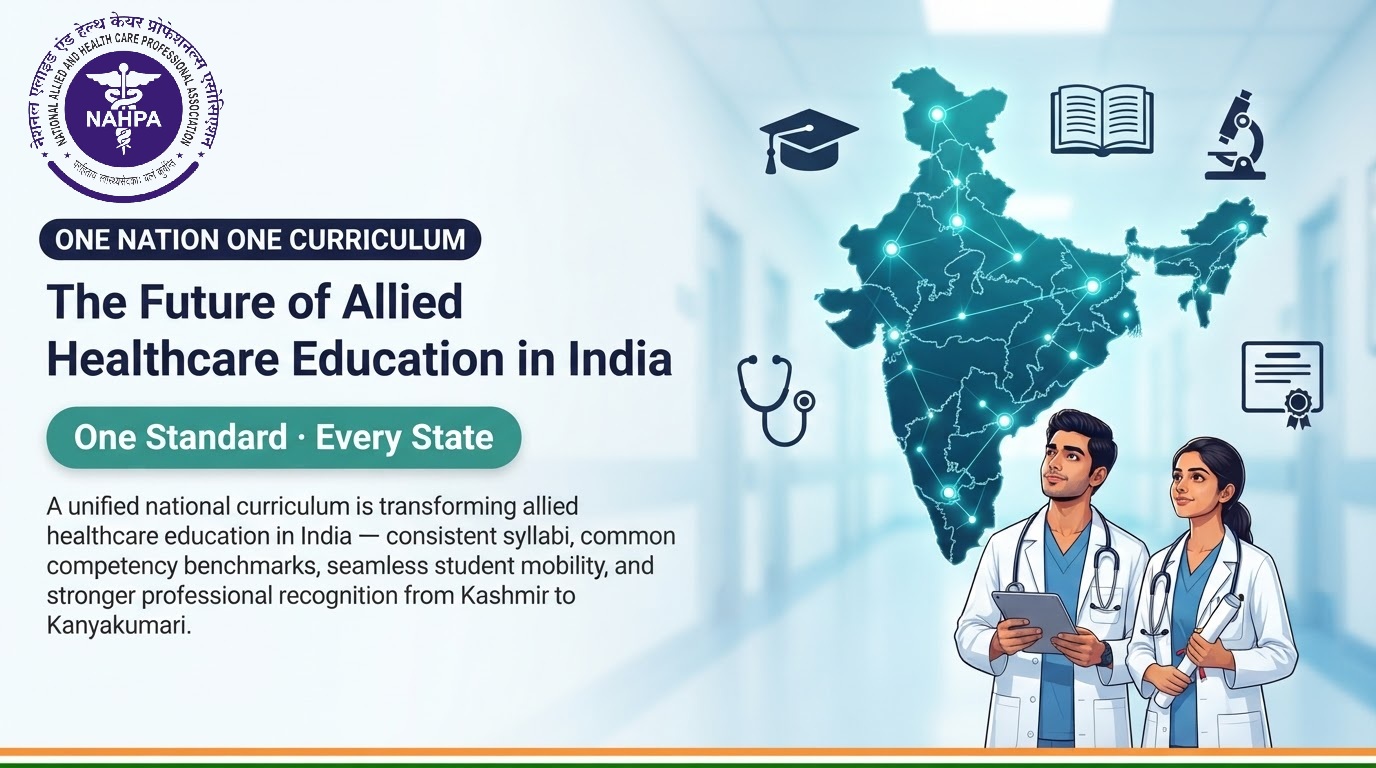
One Nation One Curriculum | The Future of Allied Healthcare Education in India | NAHPA
For decades, a BPT in one state was not the same as a BPT in another. Course names, durations and syllabi varied wildly, and employers could never be sure what a degree actually meant. That era is ending. Under the One Nation One Curriculum initiative, India is standardising allied healthcare education nationwide — one course name, one duration, one syllabus, one quality benchmark.
What Is One Nation One Curriculum?
One Nation One Curriculum is the education pillar of India's allied healthcare reform, this initiative fixes the classroom side: every recognised course across India will follow the same title, the same duration, the same competency-based syllabus and the same institutional standards — whether taught in Delhi, Chennai or Guwahati.
The April 2025 Launch: Competency-Based Curricula for 10 Professions
On 23 April 2025, the Union Ministry of Health and Family Welfare launched competency-based curricula for ten allied and healthcare professions. The launch was inaugurated by Union Health Secretary Smt. Punya Salila Srivastava, calling it “an important step in the direction of actualizing the vision of One Nation, One Curriculum.”
The first phase covered: Physiotherapy; Applied Psychology and Behavioural Health; Optometry; Nutrition and Dietetics; Dialysis Therapy Technology and Dialysis Therapy; Radiotherapy Technology; Medical Radiology and Imaging Technology; Anaesthesia and Operation Theatre Technology; Health Information Management; and Physician Associates.
The Four Principles Behind the New Curricula
| Principle | What it means |
|---|---|
| Standardization | Minimum educational standards so every graduate across India meets the same quality benchmark |
| Competency-Based Approach | Emphasis on practical application of knowledge and skills in real-world healthcare settings — not just theory |
| Holistic Development | Clinical expertise plus communication, teamwork, ethical practice and lifelong learning |
| Support for Universal Health Coverage | Building the skilled workforce India's Universal Health Coverage vision needs |
The curricula handbooks also spell out clear guidelines on course content, eligibility criteria, training delivery methods and institutional infrastructure requirements — and digital modules are being crowd-sourced so they are available to all for capacity building.
What Changes for Students from 2026-27
- BPT and BOT extended to 5 years (from 4.5 years), and Bachelor of Optometry to 5 years (from 4 years), effective from the 2026-27 academic session for fresh admissions — the added time goes into more rigorous clinical training and standardised national curriculum content. Current students continue their existing programme.
- Degrees will be recognised only if they follow the notified titles and durations — so checking a college's compliance with curricula before admission is now essential.
Why One Nation One Curriculum Matters
- Equal value everywhere: a degree earned in one state carries the same meaning and standard in every other state.
- Global recognition: uniform, competency-based training aligned with international standards — the 5-year BPT, for instance, resolves a long-standing pain point in foreign credential evaluations for licensing exams such as the US NPTE.
- Easier mobility: students and professionals can move across states (and abroad) without re-explaining or re-qualifying their education.
- Better employability: curricula aligned with industry needs mean graduates arrive job-ready; verified, standardised qualifications make hiring faster and more trustworthy.
- Patient safety: minimum standards and competency requirements keep under-qualified programmes out of the system.
Timeline: One Nation One Curriculum So Far
| Date | Milestone |
|---|---|
| March 2021 | Act 2021 passed — power to standardise education and practice |
| 23 April 2025 | Competency-based curricula launched for 10 professions (Phase 1) |
| 2026 | New curricula mandatorily implemented; UGC approves 33 new degree courses |
| Academic year 2026-27 | Rollout mandatory; BPT/BOT/B.Optom 5-year duration begins for fresh admissions |
| By 2030-31 | Full standardisation of allied healthcare education nationwide |
How NAHPA Helps
NAHPA is a national association of allied and healthcare professionals with district-level units across UP, Maharashtra, Bihar, Rajasthan, Gujarat, West Bengal, Madhya Pradesh, Tamil Nadu and other states — spreading awareness of the new curricula, NCAHP registration and CPD duties among students and professionals, and representing the workforce as the standardised education era rolls out. To connect with your district unit, visit www.nahpa.in.
FAQs
What is One Nation One Curriculum? It is an initiative of the UGC to standardise allied and healthcare course names, durations, syllabi and quality across India. The Health Ministry launched competency-based curricula for ten professions in April 2025, with curricula for other categories underway.
Which professions got the new curriculum first? The first phase covered ten professions: Physiotherapy; Applied Psychology and Behavioural Health; Optometry; Nutrition and Dietetics; Dialysis Therapy Technology and Dialysis Therapy; Radiotherapy Technology; Medical Radiology and Imaging Technology; Anaesthesia and Operation Theatre Technology; Health Information Management; and Physician Associates.
Is BPT now 5 years under the new curriculum? Yes — as reported in September 2026, UGC has approved extending BPT and BOT from 4.5 years to 5 years, and Bachelor of Optometry from 4 years to 5 years, effective from the 2026-27 academic session for fresh admissions. Enrolled students continue their existing curriculum.
How does One Nation One Curriculum help students? Uniform course titles, durations and syllabi nationwide make qualifications easier to recognise across states and abroad, align education with industry needs, enable easier mobility, and ensure every graduate meets the same minimum competency standards.